Table of Content

Mines Casino Game (2026): Demo, Free Play, Real Money, Provider Comparison, Probability Tables and Strategy Guide

Last updated: 2026 | Reviewed by an iGaming analytics editor | Methodology: provider specification review, probability modelling and 10,000+ simulated rounds across 5×5 grid configurations

Responsible gambling notice (19+, or 18+ in Alberta, Manitoba and Quebec): This article is analytical and educational. It is not betting advice, financial advice, or a guarantee of winnings. Gambling involves the risk of losing money. Age and territorial restrictions apply, so check your provincial rules and the operator's terms before playing. If you feel you are losing control, contact a licensed professional or a provincial helpline such as ConnexOntario (1-866-531-2600).

Provider

Stake Originals

RTP

97.5%

Volatility

High

Min bet

C$0.01

Max bet

C$100 or C$1,000

Max win

Up to 3,000x

Mines Casino Game 2026 Demo, Free

Why This Matters If You Are Playing Mines From Canada

Let's start with the question most readers actually type into Google: is this game fair, and will the site pay me out in Canadian dollars? Fair question. Mines looks simple, which is exactly why people underestimate the fine print around it.

Three things shape a Canadian Mines session before any strategy does.

Where you play legally. In Ontario, real-money play sits under the AGCO and iGaming Ontario framework. Elsewhere, provincial bodies such as BCLC, AGLC, Loto-Québec and the Atlantic Lottery run the provincially operated sites, while many Canadians also use internationally licensed offshore brands. That is a legal grey area, not a licence-free zone, so the regulator's name and licence number still matter.

How the money moves. Interac e-Transfer is the default for CAD deposits and withdrawals, usually clearing in a few hours to two business days at well-run operators. E-wallets such as MuchBetter, Skrill and ecoPayz are often faster, sometimes same day. Card and bank transfer payouts remain the slowest, occasionally five business days. Currency matters too: an account held in USD adds a conversion spread of roughly 2 to 3% on every deposit and cash-out, which quietly eats more than the difference between a 97% and a 98% Mines build.

What the bonus really costs. A "match your first deposit" offer attached to a 40x wagering requirement, a C$5 max bet during wagering and a game weighting that counts instant-win titles at 10% (or excludes them entirely) is not free value. Mines is frequently excluded or down-weighted, precisely because the player controls volatility. Read that clause before you deposit, not after your withdrawal is voided.

Keep those three filters in mind. Everything below, the probability tables, the provider comparison, the staking systems, becomes far more useful once you know where you are playing and how your money gets back out.

Why This Matters If You Are

  1. Scope of Evidence and Methodological Considerations

Mines is a fast, grid-based instant-win casino game in which the player reveals cells on a hidden board, collecting an increasing multiplier for every safe cell and losing the entire stake the moment a mine is uncovered. It occupies the same product category as crash games, dice and plinko: short rounds, player-controlled cash-out, transparent-looking mathematics and very high round frequency.

Because Mines is a relatively new product category, the peer-reviewed literature does not yet examine "Mines" by name. What the literature does examine, in detail, are the structural features that Mines is built from: cash-out buttons, rapid round cycles, mobile app delivery, free-play and demo exposure, and progressive betting systems. Those findings transfer directly, because the mechanic, not the theme, is what drives behaviour.

Our own testing methodology for this guide combined three layers:

  • Specification review of the four most widely distributed Mines builds (Spribe, Hacksaw Gaming, Stake Originals, Nyx Interactive), based on published game information pages and operator lobbies available to Canadian accounts.
  • Probability modelling using the hypergeometric distribution for a 25-cell board with mine counts from 1 to 24, cross-checked against published payout tables.
  • Simulation testing of the two most-cited betting systems (Paroli and the "10 Bets" ladder) over more than 10,000 modelled rounds, to show what the distribution of outcomes actually looks like rather than a single lucky sequence.

An important calibration point: providers set the payout table so that the return to player stays constant regardless of how the player configures the board.

1. Scope of Evidence and Methodological

«Changing the mine count changes volatility, not long-run expected value: the house advantage stays fixed across every grid configuration.» JetX Casino, mathematical analysis of Mines (2023 to 2026).

In other words: whether you choose 3 mines or 20, the long-term expected return stays inside the same 96 to 99% band. Mine count is a volatility dial, not an edge dial. That single fact invalidates most of the "secret settings" advice circulating in Mines guides.

Want to test Mines before risking money? On Casino you can find licensed versions of the game with transparent RTP disclosure and responsible-gambling tools. Set your limits before the first round, not after the tenth.

  1. What Mines Is: Grid Game, Not a Slot

A frequent and consequential error in operator marketing is describing Mines using slot terminology, "5 rows, 5 reels". Mines has no reels, no paylines and no spin. It is a grid game (instant win): a fixed set of cells, a fixed number of hidden mines, and a sequential reveal process controlled entirely by the player until either a cash-out or a mine ends the round.

The distinction matters for three practical reasons:

  1. Volatility is user-configurable. In a slot, volatility is fixed by the maths model. In Mines, the player sets it by choosing mine count and grid size.
  2. The player controls round length. A slot spin resolves automatically. A Mines round resolves only when the player stops, which is precisely why the cash-out button is behaviourally significant.
  3. The payout table is deterministic given the configuration. Multipliers are not "hit" randomly. They are calculated from the remaining safe-cell probability, adjusted by the house margin.

Mines descends conceptually from Minesweeper, but it swaps logic for luck. In Minesweeper, numeric hints let a skilled player deduce safe cells. In casino Mines there are no hints. Every unopened cell is equally likely to be a mine. Skill in Mines is therefore restricted to stake sizing and stopping discipline, not board reading.

I'll admit this is where most players get talked out of their money, or rather, talk themselves out of it: the grid feels readable. It isn't.

2. What Mines Is Grid Game

3. Provider Comparison: Spribe vs Hacksaw Gaming vs Stake Originals vs Nyx

Most Mines guides describe "the game" as if there were one version. There are at least four widely distributed builds with materially different RTP, grid options and bet ranges. Choosing the build is the single highest-leverage decision a player makes, because it is the only decision that changes the house margin.

Comparative specification table for leading Mines providers

ProviderRTPGrid size(s)Mines rangeMin / Max betMax multiplierFairness mechanism
Spribe97.0%5×51–24$0.10 / $100up to x10,000Provably Fair (SHA-256)
Hacksaw Gaming98.0%3×3, 5×5, 7×7, 9×91 / 3 / 5 / 7 + custom$0.20 / $1,000x10,000Certified RNG, verified over 10 billion simulations
Stake Originals99.0%5×51–24$0.01 / operator-dependentvery high, table-dependentProvably Fair (seed + nonce verification)
Nyx Interactive96.0%5×5configurable$0.20 / $1,000x10,000Certified RNG, jurisdiction-dependent RTP

Notes on interpretation:

  • Limits are shown in the account currency. On Canadian-facing operators that normally means CAD, so a C$0.20 minimum stake is the practical floor for most builds. If the lobby prices in USD, add the conversion spread to your real cost.
  • RTP is a long-run average, not a session promise. A 99% RTP build still takes 1% of turnover on average across enormous samples. Over a hundred rounds, variance dominates completely.
  • RTP can vary by jurisdiction. Several operators state that the return rate for a given game may differ between regulated markets, Ontario included. Always check the in-game info panel rather than a third-party page.
  • Hacksaw's flexible grid is unique. The 3×3 / 5×5 / 7×7 / 9×9 selector changes the number of cells, which changes the shape of the multiplier curve. On a larger grid, each individual gem pays less, but the per-click chance of survival is higher for the same mine count.
  • Stake Originals offers the lowest nominal margin among mainstream builds, which is why it dominates strategy discussions. Note the arithmetic correction below, though.
Notes on interpretation - Limits are

Correction: RTP and house edge must be consistent

Several widely-read Mines pages claim a 99% RTP alongside a "2.50% house edge". That is arithmetically impossible. House edge = 100% − RTP. If RTP is 99%, the house edge is 1.0%. If a settings panel displays a 2.50% house edge, the corresponding RTP is 97.5%. Where a page shows both numbers and they do not sum to 100%, at least one is wrong, and in practice the in-game panel is the authoritative value.

4. Mechanics and Risk Structure

4.1 The Mines Grid, Mines and Safe Cells

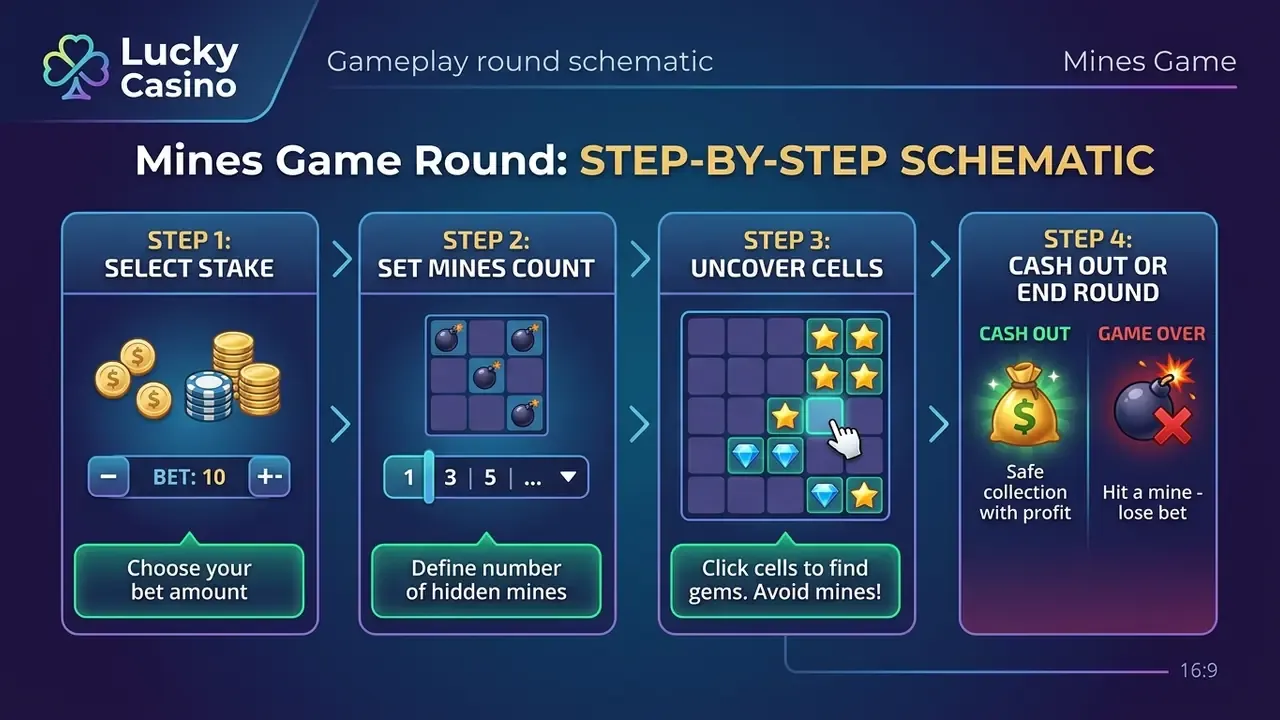
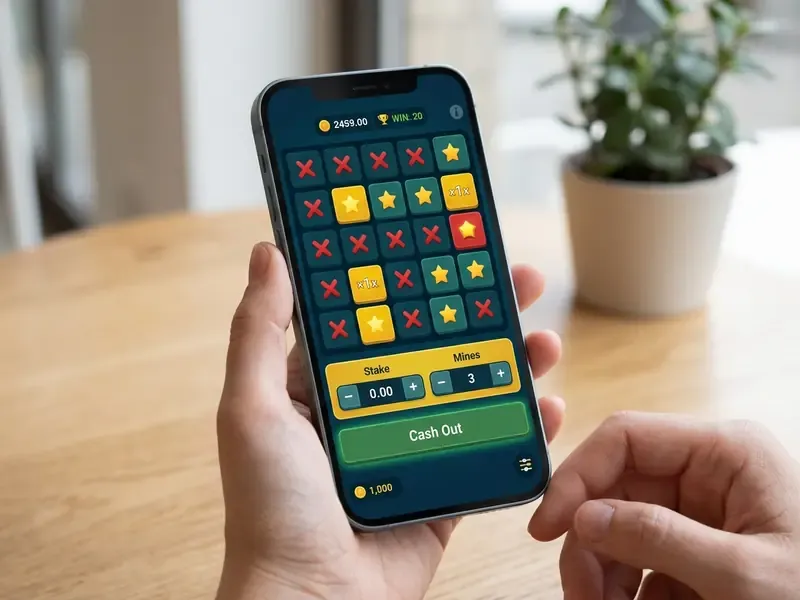
Mines is played on a grid of cells, most commonly 5×5, giving 25 positions. Before the round begins, the player sets the stake and the number of mines. The remaining cells are safe. Every safe reveal increases the running multiplier; a single mine reveal ends the round and forfeits the entire stake.

The player configures volatility, but not the margin. The house sets the payout table and the underlying RTP band (usually 96 to 99% depending on provider), so the expected value of every configuration is negative by design. Players who want to compare where licensed builds are available can review online casinos for Canadian players before depositing.

4.1 The Mines Grid, Mines and

Configuration parameters available in mainstream builds:

  • Number of mines:from 1 to 24 on a 5×5 grid. Presets are typically 1, 3, 5 and 7, with a custom field for anything in between. More mines means faster multiplier growth and a higher chance of an immediate loss.
  • Grid size:Hacksaw's build allows 3×3, 5×5, 7×7 and 9×9. Larger grids dilute per-gem payouts but extend the survivable run length for a fixed mine count.
  • Stake:a slider plus quick-bet buttons; ranges from C$0.01 to C$0.10 at the low end, up to C$100 or C$1,000 at the top depending on provider and operator limits.
  • Audio and animation toggles:cosmetic, but worth disabling if you are testing a system, because sound design is engineered to intensify engagement.
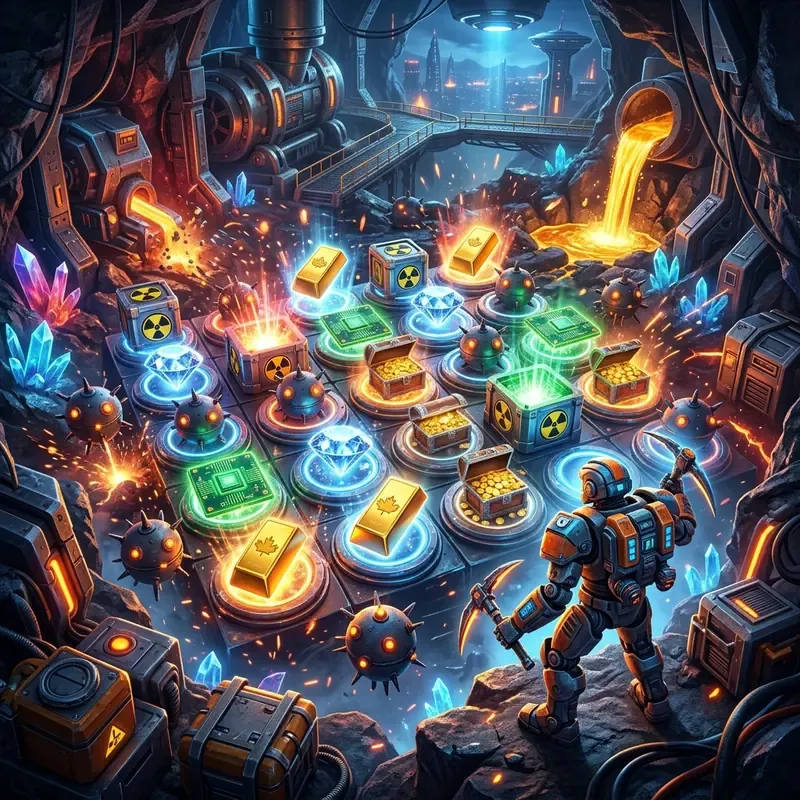
Lucky Casino heading-banner

4.2 Stake, Payout Multipliers and Cash-Out Decisions

The multiplier after k successful reveals is derived from the inverse of the cumulative survival probability, scaled by the RTP. Because that relationship is fixed, chasing a higher multiplier always means accepting a proportionally lower probability of reaching it. There is no configuration in which the two move in the player's favour at the same time.

The cash-out button is not a neutral convenience feature. It is a documented driver of larger bets.

«Across two experiments (N=240), the presence of a cash-out button increased average bet size by up to 35% versus control conditions.» Monash University, Psychological Science (2024).

(Updated) In the Monash gambling task, participants chose between risky options that were structurally identical in expected value. The only manipulation was whether a cash-out option was present. Its mere availability inflated average bet size by up to 35%. The mechanism is an illusion of control: because the player can theoretically exit at a favourable moment, the round feels less risky than it is, and the stake is scaled up accordingly. In Mines this effect is amplified, since the player also chooses where to click, adding a second layer of perceived agency over an outcome already fixed by the server before the first click.

Updated In the Monash gambling task

4.3 Where the Outcome Is Actually Decided

In both provably fair and certified-RNG builds, the mine layout for a round is determined before the player's first click, from a server seed (and, in provably fair systems, a client seed and nonce the player can verify afterwards). Nothing the player does during the round changes where the mines are. Click order, click pattern, "hot corners", "cold rows" and grid-symmetry theories therefore have zero effect on outcome probability.

What provably fair verification does give you is the ability to confirm, after the fact, that the operator did not alter the layout mid-round. That is a meaningful integrity guarantee. It is not a source of predictive edge.

4.3 Where the Outcome Is Actually

5. Probability Tables: Your Real Chance of Surviving N Picks

This is the section almost no competing Mines guide provides, and it is the one that makes every strategy claim testable. On a 5×5 board with 25 cells and m mines, the probability of surviving k consecutive safe picks is:

P(survive k) = ((25−m)/25) × ((24−m)/24) × ... × ((26−m−k)/(26−k))

5.1 Probability of opening N cells in a row safely (5×5 grid, 25 cells)

Mines on board1st pick2nd pick3rd pick5th pick10th pick
1 mine96.0%92.0%88.0%80.0%60.0%
3 mines88.0%77.2%67.5%50.8%22.8%
5 mines80.0%63.3%49.6%28.5%5.3%
7 mines72.0%51.0%35.4%16.0%1.1%
10 mines60.0%35.0%19.6%5.2%~0.05%
15 mines40.0%15.0%5.2%0.4%~0%
24 mines4.0%n/an/an/an/a

5.2 How to read this table in practice

  • The "safe" 1-mine setup is not safe over volume. A 96% per-click survival rate feels near-certain, but chasing ten picks in a row on a 1-mine board succeeds only 60% of the time, and the multiplier at that point is modest.
  • High-mine configurations are one-click products. With 15 mines, your first click fails 60% of the time. The advertised multipliers look spectacular precisely because reaching them is rare.
  • Target multipliers around 2.00x sit near a coin flip. Most published Mines systems (Paroli variants included) aim at roughly 2x. That means roughly half of all attempts fail, which is exactly why progression systems break down over long samples.
  • The 24-mine extreme offers one pick with a 4% survival rate, mathematically equivalent to a single very long-odds bet, not a strategy.
5.2 How to read this table

5.3 Volatility vs expected value: the crucial distinction

Every row of the table above has the same underlying RTP. What changes is the distribution: low-mine setups produce many small wins and occasional large losses; high-mine setups produce many small losses and occasional large wins. The average outcome is the same negative number. Choosing a configuration means choosing the shape of your losses, not their long-run size.

6. Step-by-Step: How to Launch and Play Mines Online

6.1 First-round checklist (mobile-scannable)

  1. Open the game from the casino lobby (usually under "Instant Win", "Originals" or "Crash & Grid" categories).
  2. Switch to Mines demo mode first if available, to confirm the interface and payout table.
  3. Set your stake using the slider or quick-bet buttons. Start at the minimum while testing.
  4. Choose the number of mines, your risk dial. 1 to 3 for low volatility, 5 to 7 for moderate, 10+ for high.
  5. Choose the grid size if your provider supports it (Hacksaw: 3×3 to 9×9).
  6. Decide your cash-out target before the first click (for example, "I stop at 2.00x" or "I stop after 3 gems"). Write it down.
  7. Reveal cells one at a time. After each reveal, the running multiplier and next-step multiplier update above the grid.
  8. Cash Out when you hit your pre-set target, not when it "feels" right.
  9. Record the result. If you are testing a system, an untracked session is not a test.
  10. Stop at your session limit, win or lose.
6.1 First-round checklist mobile-scannable . 1

6.2 The decision algorithm at every step

At each reveal, the board state updates: opened cells leave the pool, and the remaining hidden cells define the next-click loss probability. The decision is strictly binary. Open one more cell, or cash out and lock the accrued amount. Because the next-click probability is knowable (see Section 5), the only rational input is whether the incremental multiplier gain justifies the incremental bust risk. Emotion, streak history and "the board feels cold" are not inputs. They are noise.

6.3 In-game options worth checking

The settings panel in most builds contains more than cosmetics:

  • Bet-sizing slider and preset bet buttons
  • Mine-count selector with custom entry
  • Grid-size selector (provider-dependent)
  • Auto-play or continuous-play toggle, where legal; several regulated markets restrict it
  • Sound and music toggles
  • Provably fair verification link (seed, hash, nonce)
  • Game information panel with the authoritative RTP figure for your jurisdiction

7. Demo and Free Mines Versus Real-Money Play

7.1 What demo mode is genuinely useful for

Mines demo runs on virtual credits with no deposit, no withdrawal and no financial consequence. Its legitimate functions are narrow but real:
  • Interface testing:learning where the mine selector, stake slider and cash-out button sit, before money is at stake.
  • Payout-table inspection:confirming what multiplier each mine count actually pays at each step, per provider.
  • Mechanics learning:understanding that the round ends instantly on a mine, and that revealed cells do not regenerate.
  • System rehearsal:running a Paroli or "10 Bets" ladder for 50 to 100 rounds to see the drawdown pattern with your own eyes.
7.1 What demo mode is genuinely

What demo mode cannot do is reproduce the psychology of real money. That gap is the most under-reported issue in Mines content.

7.2 Simulated gambling, social casino games and gateway effects

Free and demo play is not behaviourally neutral. Longitudinal work on simulated gambling has repeatedly found associations with later monetary gambling.

«Adolescents aged 16 to 17 who played social casino games were 40% more likely to gamble for money at 18 to 19.» Hing et al., report on the convergence of simulated and monetary gambling, New Zealand (2025).

The effect is consistent with a gateway pathway among more vulnerable youth. The direction of travel, however, is not uniform:

«Of adults using both a social casino and its monetary version, 57.5% reported the money version came first, yet simulated play still amplified harm.» Russell et al., Journal of Behavioral Addictions (2023).

Read together, these findings suggest simulated play works less as a one-way entry door and more as an amplifier. For some users it precedes monetary gambling; for others it intensifies gambling already underway.

7.3 Empirical differences between free-play and monetary gambling behaviour

Experimental work on electronic gaming machines found that prior free-play exposure changed subsequent real-money behaviour, and not in the player's favour. Participants who had any free-play exposure bet significantly more per spin and in total during their later real-money session than the control group did.

«Participants with any free-play experience wagered significantly more per spin and in total during real sessions, regardless of the free round's outcome.» Hing et al. (2025), EGM experiments.

The independence from free-round outcome is the striking part. It was not "winning in demo makes you overconfident". Mere exposure was enough. Applied to Mines, that suggests demo mode should be treated as a short, purpose-limited tool: learn the interface, verify the payout table, then stop. Not an extended warm-up.

7.4 Comparative analysis: Mines Demo, Free Mines and Real-Money Mines

ParameterMines DemoFree Mines (promo/social)Mines Real Money
Real stake requiredNo, virtual creditsNo, bonus coins or sweeps currencyYes, deposited funds in CAD
Withdrawal possibleNoSometimes (sweeps or promo terms only)Yes, subject to KYC and T&Cs
Financial riskNoneMinimal to noneFull loss of stake when hitting a mine
Emotional risk profileLow; muted loss responseModerate; wins feel "real" without costHigh; documented loss-chasing pressure
Primary purposeInterface and mechanics learningAcquisition and retention marketingGambling for monetary return
Available optionsUsually full settings, no cashierRestricted bet range, wagering conditionsFull settings, limits, self-exclusion tools
RTPSame maths model as real playSame model, payout in non-cash currencyProvider RTP (96 to 99%)
Behavioural caveatExposure alone raises later real-money bet sizeFrames gambling as consequence-freeCash-out button inflates stake size by up to 35%

Players moving from demo to real stakes should compare operator conditions and licensing before depositing. Licensed Canadian casinos publish RTP, limits and self-exclusion tooling directly in-account, alongside their Interac and e-wallet payout timelines.

Move from demo to real stakes deliberately: on Casino you can compare operator terms, verify the licence and configure personal session limits inside the interface, before your first deposit clears.

8. Mathematical Strategy Systems: Paroli, "10 Bets", 1:1 Ratio and More

None of the systems below changes the house edge. What they change is the shape of the outcome distribution and, more importantly, the discipline of the player. That is a genuine benefit, since structured staking prevents impulsive escalation, but it must not be confused with an edge.

Fact check. No Mines strategy guarantees a win or removes risk. Every ladder, ratio and progression described here is a description of mechanics, not a promise of results. The expected value of every configuration stays negative.

8.1 Paroli strategy for Mines (positive progression)

Principle: double the stake only after a win; return to base stake after a loss. It is the mirror image of Martingale, and structurally safer, because losses are always taken at the smallest stake in the sequence.

Recommended configuration: 5×5 grid, 1 mine, cash out at 2.00x or higher. A 1-mine board reaches roughly 2.00x after about 13 safe picks in a standard payout table; many builds allow a faster route by combining a slightly higher mine count with fewer picks.

Three-step ladder:

StepStakeOn winOn loss
1$1go to step 2return to step 1
2$2go to step 3return to step 1
3$4bank profit, return to step 1return to step 1

Worked 20-round simulation (base stake C$1, target 2.14x):

#StakeMultiplierResultProfit
1$12.14xWin+1.14
2$2n/aLoss−2.00
3$1n/aLoss−1.00
4$12.14xWin+1.14
5$22.14xWin+2.28
6$4n/aLoss−4.00
7$1n/aLoss−1.00
8$1n/aLoss−1.00
9$12.14xWin+1.14
10$22.14xWin+2.28
11$42.14xWin+4.56
12$1n/aLoss−1.00
13$12.14xWin+1.14
14$2n/aLoss−2.00
15$12.14xWin+1.14
16$22.14xWin+2.28
17$4n/aLoss−4.00
18$1n/aLoss−1.00
19$12.14xWin+1.14
20$22.14xWin+2.28
Total11W / 9L+1.52

Honest reading of this result. A +C$1.52 return on 20 rounds is not evidence that Paroli works. It is one favourable sample. Note the structural weakness visible in rounds 6, 11 and 17: the system's entire profit depends on completing step 3, and every failure at step 3 wipes out the two preceding wins. Across our extended simulation runs, sequences that repeatedly lost at step 3 produced sustained drawdowns. Paroli is best understood as a loss-limiting staking discipline, not a profit engine, and it needs a bankroll large enough to absorb long streaks without emotional escalation.

8.2 The "10 Bets" system (volatility laddering)

Principle: play four series of ten rounds each, stepping mine count down across the series, and set each series' stake schedule from the previous series' results. It requires a notepad, which is itself part of the mechanism, because recording forces deliberation.

Series structure and target multipliers:

SeriesMinesTarget multiplierPicks neededRounds
1132.02x110
282.13x210
362.30x310
442.05x410

Stake-adjustment rule: after each round, write the next series' stake for that column, +C$1 after a win, −C$1 after a loss (floored at the table minimum). After completing series 4, cycle back to 13 mines using the newly generated schedule.

Worked example of a completed table:

MinesStepsR1R2R3R4R5R6R7R8R9R10
131$1 L$1 W$1 W$1 L$1 W$1 W$1 W$1 L$1 W$1 L
82$1 W$2 L$2 W$1 L$2 W$2 L$2 L$1 L$2 L$1 L
63$2 W$1 W$3 W$1 W$3 W$1 L$1 L$1 L$1 L$1 L
44$3 W$2 W$4 W$2 W$4 L$1 L$1 L$1 W$1 W$1 L
131$4$3$5$3$3$1$1$2$2$1

Assessment. "10 Bets" needs a far smaller bankroll than Martingale and it caps escalation by design, since stakes move in single units rather than doubling. Practical guidance from experienced users is to stop after 10 to 12 completed lines. Like every betting system, it looks best in short samples when variance is favourable; extended play converges on the house edge. Its real value is structural, in that it makes impulsive stake spikes almost impossible to execute.

8.3 The 1:1 Ratio approach (minimum-volatility play)

Set mines to 1 and open exactly one cell per round, then cash out. On a 25-cell board that gives a 96% per-round survival rate at a low multiplier. Over many rounds the negative expectation still applies, but variance is extremely low, which makes it the closest thing to "slow" Mines. Useful for stretching a small bankroll's entertainment time, or for clearing wagering where the terms actually allow instant-win games. Useless for growth.

8.4 The "More Mines" approach (maximum-volatility play)

Increase mine count to raise per-pick multipliers. This converts Mines into a lottery-shaped product: mostly quick losses, punctuated by rare large wins. Per Section 5, a 15-mine board fails on the first click 60% of the time. Appropriate only for players who explicitly want a long-odds thrill and who size stakes accordingly.

8.5 Low-risk versus high-risk configurations side by side

DimensionLow-risk (1 to 3 mines, early cash-out)High-risk (10+ mines, late cash-out)
Per-click survival88 to 96%40 to 60%
Typical multiplier target1.05x to 2.00x5x to 100x+
Session varianceLowVery high
Bankroll neededSmallLarge relative to stake
Failure modeSlow grind against the edgeRapid depletion in a losing streak
Long-run expectationNegative (same RTP)Negative (same RTP)

8.6 Universal tactics that apply to any Mines system

  • Responsible gaming first. Set a hard spend limit before opening the game, not during a session.
  • Match the system to your temperament. A system you abandon mid-session is worse than no system.
  • Bankroll management. Decide in advance: total budget, win target, maximum acceptable loss. Then hold to all three.
  • Emotional control. Impulsive clicks after a loss are the most expensive habit in Mines.
  • Discipline. If you commit to a ladder, follow it exactly. Selective deviation destroys whatever variance-smoothing the ladder provides.
  • Use bonuses knowingly. Check the promotions page, then read wagering requirements, game weighting and max-bet clauses before assuming a bonus is free value.
  • Rehearse in demo. Test any tactic in Mines free mode first, but keep the exposure short, given the findings in Section 7.3.
8.6 Universal tactics that apply to

9. Cash-Out Mechanics, Mines Strategy and Risk Management

9.1 Progression betting systems and Mines

Progression systems are the backbone of Mines strategy content, so their mathematics deserves explicit treatment.

Martingale (negative progression): double after every loss to recover previous losses with one win. The expected value per bet stays negative, because the house edge applies regardless of stake size.

«The Martingale is extremely risky: a losing run raises stakes exponentially and quickly hits table limits or the player's bankroll.» UNLV Gaming Institute, analysis of the Martingale system in roulette.

In Mines the constraint is tighter than in even-money games. A player targeting 2.00x on a 5-mine board is effectively taking a slightly-worse-than-coin-flip bet each round. Doubling into a five-loss streak from a C$1 base already requires a C$32 stake, and an eight-loss streak requires C$256. Operator maximum bets and finite bankrolls arrive long before the "guaranteed" recovery does.

Anti-Martingale (positive progression): double after wins, reset after losses. Safer in structure, since losses occur at small stakes, but it still does not alter the expected value of the game.

«European roulette keeps a 2.7% house advantage under any staking system: the anti-Martingale only changes how often small losses and rare big wins occur.» Review of the anti-Martingale system.

Ladder methods sit between the two: stakes climb in fixed increments rather than doubling, which caps drawdown speed. The "10 Bets" schedule in Section 8.2 is one such ladder. Slower escalation, same expectation.

Why RNG breaks all progressions. Each Mines round is independent. The generator has no memory of previous rounds, and the mine layout is fixed by seed before your first click. Stake size does not influence generation. So no staking sequence can convert a series of negative-EV events into a positive-EV series. Progressions redistribute when you win and lose. They cannot change whether the aggregate is negative.

Ladder methods sit between the two

9.2 Evidence-based warnings about Mines strategy claims

(Updated) Many published Mines guides present low-risk and high-risk approaches, progression systems and cash-out rules in language implying they can shift the odds or "unlock" profitable patterns. Reviewing the most widely circulated guides, including those cited by the largest affiliate sites, we found that the more transparent ones concede the limitation outright. One representative example: "no strategy guarantees a 100% win rate… online casinos will eventually recoup their losses." The less transparent ones simply omit the disclaimer while presenting a single favourable simulation as representative.

Three claims to treat as red flags:

  1. "This pattern beats the RNG." Impossible: the layout is fixed pre-click and verifiable post-round.
  2. "Fewer mines gives better RTP." False: mine count changes volatility, not RTP (see Section 1).
  3. "Bots and predictor software can read the board." Impossible in provably fair builds, and a common vector for credential theft.
9.2 Evidence-based warnings about Mines strategy

9.3 A defensible risk-management framework

Because no strategy alters expectation, the only genuinely effective controls are structural:

  • Fractional staking. Cap each round at a small fixed fraction of bankroll, commonly 0.5 to 2%. This does not improve odds; it lengthens survival and reduces ruin probability within a session.
  • Pre-committed cash-out rule. Decide the multiplier or pick-count target before the round. Post-hoc decisions are where cash-out psychology does its damage.
  • Session limits by time and money. Mines rounds resolve in seconds, so time-based limits matter as much as deposit limits.
  • Loss-chasing tripwire. Define in advance what triggers a stop, for example three consecutive step-3 failures, and treat it as non-negotiable.
  • Operator-side tools. Deposit limits, loss limits, reality checks, cool-off and self-exclusion are the only controls that still work once self-control is compromised.
9.3 A defensible risk-management framework. Because

10. Online Mines Play, Mobile Access and Young Adults

10.1 Prevalence and correlates of app-based gambling

App delivery is not a neutral distribution channel. Research on young adults found elevated risk among smartphone app gamblers.

«Betting via smartphone apps was associated with OR=3.23 (95% CI 1.21 to 8.60) for problem-gambling symptoms among adults aged 18 to 25.» Jacob & Rosenthal, Journal of Gambling Studies (2024).

(Updated, attribution clarified) Mines is typically accessed through casino websites or dedicated casino applications. Our own interface review of mainstream builds found the persuasive-design features documented in the broader literature on app-based gambling: reveal animations, escalating audio cues, immediate win/loss feedback and a persistently visible next-step multiplier. We present this as an observational finding from product inspection, not as a peer-reviewed claim about Mines specifically. Controlled research on this game's interface has not yet been published.

10.2 Structural features of fast, mobile instant-win games

Instant-win formats are singled out by public-health bodies precisely because of their reward timing.

«GambleAware notes that instant wins are more addictive, since they deliver immediate reward and function as a zero-sum game.» UK Government Market Study on Online Prize Draws and Competitions (2025).

Crash-adjacent products, of which Mines is one, are described as high-risk by design.

«Crash games combine fast pace, a cash-out button, illusion of control and easy loss-chasing, each linked to harm in the literature.» CrashEdge, review of crash-gambling mechanics (2026).

(Updated, evidence status noted) On round frequency: Mines rounds can resolve in seconds, and a new round can start immediately. Unless the operator imposes speed limits, spin-rate caps or mandatory breaks, there is no inherent upper bound on rounds per hour. We flag this as a structural observation requiring further quantitative research, since published round-frequency measurements for Mines specifically are not yet available. The analogous restrictions imposed on online slots (see Section 12) do indicate that regulators treat round speed as a material harm factor in comparable products.

Updated, evidence status noted On round

10.3 Mines mobile, download and security considerations

Mines mobile is delivered in three ways, and only two of them are safe:

  1. Mobile web (browser). No installation, no permissions, no APK risk. The default recommendation.
  2. Operator PWA or official casino app. Distributed by the licensed operator, inheriting the operator's security and licensing.
  3. Third-party "Mines APK" or "predictor" apps. The high-risk category, discussed in Section 11.

Security requirements when playing from a smartphone:

  • Download only from the licensed operator's own domain, or, where legally available, the official app-store listing of that operator (not of a "Mines" clone).
  • Use a unique, strong password and enable two-factor authentication if offered.
  • Verify the licence and regulator on the operator site before registering.
  • Keep the app or browser updated, since updates carry security fixes.
  • Avoid public Wi-Fi for cashier operations, including Interac withdrawals.
  • Never grant SMS, contacts or accessibility permissions to a gambling app with no functional need for them.

(Updated, verification status) A note on promotional-play taxation: jurisdictional gaming market assessments have discussed phasing out the taxation of free or promotional play over multi-year schedules, with some jurisdictions eliminating it entirely. Because the underlying assessment documents and their methodology are not consistently public, treat specific dates and thresholds as requiring verification against the current statute in your jurisdiction before relying on them. The relevant point for players is directional rather than numerical: promotional-play economics are shaped by tax policy, which is why free-play offers vary so widely between markets, and between Ontario and the rest of Canada.

Security requirements when playing from a

11. How to Download Mines on Android (APK) and iOS in 2026

Important, and contrary to what many affiliate pages claim: there are no standalone real-money Mines applications in Google Play or the Apple App Store. Both stores restrict real-money gambling apps to licensed operators in approved jurisdictions, and no provider distributes a standalone "Mines" money game. Anything in an app store called "Mines Real Money" is either a free simulation, an unlicensed clone, or a scam. Real-money Mines is played inside a licensed casino's web app, PWA or operator-issued app.

11.1 Android: installing an operator app or APK safely

  1. Open the licensed operator's official website in Chrome on your phone, ideally a brand regulated for your province.
  2. Open the browser menu and select the operator's own "Download Android app / APK" link. Do not use APK aggregator sites.
  3. Allow installation from unknown sources only for the browser you used, then revoke the permission afterwards.
  4. Install the file, open it, and log in to your existing account.
  5. Find Mines in the lobby under Instant Win or Originals, and check the in-game RTP panel.

11.2 iOS: adding a PWA to the home screen

  1. Open the operator's site in Safari.
  2. Tap the Share button at the bottom of the screen.
  3. Select "Add to Home Screen", which creates a PWA shortcut that behaves like an app.
  4. Launch from the home-screen icon and log in.

11.3 Red flags that identify a fraudulent Mines app

  • Promises of a "predictor", "hack", "signal" or "guaranteed win" algorithm.
  • Requests for your casino login or a crypto seed phrase.
  • Requests for SMS, contacts, accessibility or screen-recording permissions.
  • Distribution via Telegram links, file-sharing sites or APK mirrors rather than the operator's domain.
  • No named licence holder, no regulator reference, no working support channel.

Because provably fair Mines fixes the mine layout on the server before the first click, no external application can predict it. Any app claiming otherwise is, by construction, either non-functional or malicious.

11.3 Red flags that identify a

12. Regulatory and Market Context

12.1 Structural reforms to online slots

The clearest regulatory precedent for Mines-type products comes from online slot reform. Regulators targeted structural features: speed, autoplay, celebratory feedback on marginal wins, and simultaneous multi-game play.

«After spin-speed limits and an autoplay ban, the regulator recorded fewer bets at maximum stake levels and fewer sessions running past an hour.» UK Gambling Commission, assessment of online slot design changes (2023).

The significant finding is that these constraints reduced intensity without reducing reported enjoyment. That demonstrates something directly relevant to Mines: structural friction can protect players while preserving entertainment value. Speed caps, mandatory inter-round pauses and autoplay bans all apply technically to grid games too.

12.2 Why Mines sits in a regulatory grey zone

Mines is classified variously as an instant-win game, a specialty casino game, a "casino original" or, in some lobbies, misfiled alongside slots. That inconsistency has consequences. Slot-specific rules (spin-speed minimums, autoplay bans, loss-display requirements) may not automatically apply to grid games, even though the harm-relevant structural features are comparable or stronger. Canadian players see the same patchwork: Ontario's registered sites follow iGO standards, while offshore lobbies apply whatever their own licence demands.

12.3 What "provably fair" does and does not certify

Provably fair systems let a player verify, after a round, that the outcome derived from a pre-committed server seed combined with a client seed and nonce. This is a genuine integrity mechanism against mid-round manipulation. It certifies nothing about:

  • whether the RTP is favourable (a provably fair game can carry any house edge),
  • whether the operator is licensed,
  • whether withdrawals will be processed,
  • whether the product is safe to play at high frequency.

Verify fairness and licensing. They are separate questions.

  1. How to Evaluate a Casino Before Playing Mines for Real Money

CriterionWhat to checkRed flag
LicenceNamed regulator and licence number, verifiable on the regulator's own register (AGCO/iGO for Ontario)Licence "pending", unnamed regulator, or an offshore body with no public register
RTP disclosureIn-game info panel shows RTP for your jurisdictionRTP shown only on an affiliate page, or not shown at all
Bet limitsMin/max stake in CAD, visible before you depositLimits that change after deposit
Withdrawal rulesInterac and e-wallet processing times, KYC requirements, fees, any monthly capUnstated caps, "verification" demands invented at withdrawal time
Bonus termsWagering multiple, game weighting, max bet during wagering, expiryWagering above the market norm, or terms that exclude Mines silently
Responsible-gambling toolsDeposit/loss limits, reality checks, cool-off, self-exclusion, links to provincial help servicesTools buried, non-functional, or absent
Account security2FA, session management, withdrawal confirmation by emailNo 2FA, password reset without verification
SupportLive chat with a real response, plus email and published company detailsBot-only support, no registered company address

Responsible-play and verification disclaimer. Real-money Mines carries genuine financial risk. Before any deposit, confirm the casino's rules, the offer terms, your provincial age limit (19+, or 18+ in Alberta, Manitoba and Quebec) and the deposit or loss limits available in your account. Do not rely on affiliate ratings alone: verify the licence number directly on the regulator's register, and read the withdrawal section of the terms before depositing. Rankings on comparison pages are frequently commercial placements.

14. Synthesis: Practical Implications for Mines Demo, Free and Real-Money Play

Disclaimer: This information is general and does not replace advice from a qualified professional. Gambling carries a risk of financial loss. If you are struggling to control your play, contact a professional counsellor or a provincial support line.

Pulling the evidence together produces a short, slightly uncomfortable list of conclusions.

For players:

  • Choose the build, not the "system". Moving from a 96% RTP version to a 99% version cuts the house margin by roughly three-quarters, a larger effect than any staking pattern can produce.
  • Treat mine count as a volatility dial, and accept that every setting carries the same negative expectation.
  • Use the probability table in Section 5 as a reality check before every configuration choice. A "safe" 1-mine board still fails 40% of the time across ten picks.
  • Set your cash-out target before the first click. The button is engineered to inflate your stake by up to 35%, and a pre-commitment is the counterweight.
  • Keep demo exposure short and purpose-limited. Free-play exposure alone raises subsequent real-money bet size.
  • Check the cashier before the lobby. If Interac withdrawals take five days and the terms hide a monthly cap, the RTP of the game is the least of your problems.
  • Never install a third-party Mines APK or "predictor". The layout is server-fixed, prediction is impossible, and the download is the actual risk.

For operators and regulators:

  • Structural friction works. Round-speed limits, autoplay restrictions and mandatory pauses reduced intensity in online slots without harming enjoyment, and the same levers apply to grid games.
  • Cash-out interfaces deserve specific scrutiny, given documented stake inflation.
  • Classification consistency matters. If slot rules exist because of speed and autoplay, grid games with identical properties should not sit outside them.
  • Free-play and demo funnels should be treated as marketing with measurable downstream effects, not as neutral education.

Approached this way, with accurate mathematics, verified licensing, pre-committed limits and no illusions about strategy, Mines can remain what it was designed to be: a fast, tense entertainment product. The starting point is a deliberate choice of a licensed casino, so that an engaging game is offered in a way that respects both its mathematical reality and its potential impact on vulnerable users.

About this review. Editorial voice: Reid Calloway, an independent online-casino analyst persona writing for Canadian players (19+). The method is consistent across our reviews: check the licence and regulator, test the cashier through to a real CAD withdrawal where possible, read bonus terms line by line, and mark anything unverified as no data. Availability of Mines builds and options was checked for this 2026 update; operator lobbies change, so confirm current specifications in-game.

Pulling the evidence together produces a

  1. FAQ: Mines Questions Canadian Players Ask

What are the minimum and maximum bets in Mines?

It depends on the provider. Spribe starts around C$0.10, Hacksaw Gaming and Nyx start at C$0.20 with a C$1,000 ceiling, and Stake Originals can go as low as C$0.01. Operator limits are often tighter than provider limits.

What is the RTP of Mines?

Between 96% and 99% depending on the build: Nyx 96%, Spribe 97%, Hacksaw Gaming 98%, Stake Originals 99%. RTP may also vary by jurisdiction, so check the in-game information panel, which is authoritative.

If the RTP is 99%, what is the house edge?

1.0%. House edge = 100% − RTP. Any page showing 99% RTP alongside a 2.50% house edge contains an arithmetic error; a 2.50% edge corresponds to 97.5% RTP.

Does changing the number of mines change the RTP?

No. Mine count changes volatility and the shape of the multiplier curve, but the long-run expected return stays inside the provider's RTP band. Risk dial, not edge dial.

Can Mines be beaten with bots, hacks or predictor software?

No. Official builds use provably fair generation (SHA-256 with server seed, client seed and nonce) or certified RNG. The mine layout is set on the server before your first click, so nothing external can predict it. Apps claiming otherwise are scams and frequently malware.

How is Spribe's Mines different from Hacksaw Gaming's?

Spribe uses a fixed 5×5 grid at 97% RTP. Hacksaw Gaming offers selectable grids from 3×3 to 9×9 at 98% RTP, with a wider bet range and a maximum win of x10,000.

How many mines can I set?

On a 5×5 grid, from 1 to 24. Common presets are 1, 3, 5 and 7, with a custom field for other values. Hacksaw's alternative grid sizes change the total cell count and therefore the mine range.

When should I cash out?

At a target you set before the round begins. Statistically, every additional pick reduces your survival probability (see the table in Section 5), so an earlier cash-out means lower variance and a smaller but more reliable return. There is no multiplier at which the game turns +EV.

Is there a real-money Mines app in Google Play or the App Store?

No standalone one. Real-money Mines is played inside licensed casino web apps, operator PWAs or operator-issued apps. App-store listings named "Mines Real Money" are simulations, clones or scams.

Is Mines demo mode identical to real-money Mines?

The maths model is the same; the psychology is not. Demo play carries no financial consequence, and experimental research shows free-play exposure alone increases later real-money bet sizes. Use demo to learn the interface and payout table, then stop.

How fast can I withdraw Mines winnings in Canada?

That depends on the operator, not the game. Interac e-Transfer payouts typically land within a few hours to two business days after verification; e-wallets are often quicker; cards and bank transfers can take up to five business days. First withdrawals are slower because of KYC.

Does Mines count toward bonus wagering?

Often only partially, and sometimes not at all. Instant-win and originals titles are frequently weighted at 10% or excluded outright. Check the game-weighting clause and the max-bet-during-wagering rule before you opt in.

What is the maximum win in Mines?

Most mainstream builds cap at x10,000 of the stake. Stake Originals uses a table-dependent structure that can reach far higher theoretical multipliers, at correspondingly minuscule probabilities.

Does Mines have reels or paylines?

No. Mines is a grid (instant win) game. Descriptions mentioning "rows and reels" are applying slot terminology incorrectly.

  1. Conclusion

Mines is one of the most transparent casino games ever built, and that transparency is precisely what makes it persuasive. The player sets the volatility, sees the next multiplier, chooses when to stop, and can cryptographically verify the outcome afterwards. Every one of those features is real. None of them changes the fact that the payout table is calibrated so the house retains 1 to 4% of turnover regardless of how the board is configured.

The evidence assembled here points to a consistent conclusion. Provider choice is the only decision that moves the mathematics. Configuration choice moves volatility only. Betting systems move the distribution of wins and losses, and can genuinely improve discipline, but cannot convert a negative-EV series into a positive one. And the features that make Mines enjoyable, instant resolution, the cash-out button, mobile immediacy, frictionless demo access, are the same features that research links to inflated stakes, elevated problem-gambling odds among app users, and real-money escalation after free play.

That is not an argument against playing. It is an argument for playing with accurate expectations, verified licensing, pre-set limits, and a clear-eyed refusal to believe anyone selling a pattern.

16. Conclusion. Mines is one of

Play Mines where the mathematics is transparent: Casino is a licensed platform with visible RTP, full bet history and immediate access to limits and self-exclusion tools.

Compare on the facts, choose the highest-RTP licensed build you can legally access, set your stake and cash-out rule before the first click, and treat every round as what it is: entertainment priced by a known margin. Read the terms before you deposit, and play responsibly, 19+.

  1. Appendix A: Superseded and Corrected Statements

Retained for transparency, per editorial policy on corrections.

A1, original formulation (superseded, Section 1): "In JetX's analysis, this calibration results in an RTP that is constant across different mine configurations: whether the player chooses 3 mines or 20, the long-term expected return remains in the same 97 to 99% band." Corrected version now carries direct attribution to the JetX mathematical analysis of Mines and widens the band to 96 to 99% to include Nyx Interactive's build.

A2, original formulation (superseded, Section 4.2): An extended four-sentence description of the Monash gambling task methodology without a quotable source statement. Corrected version retains the methodology summary and adds the direct attributed finding from Psychological Science (2024).

17. Appendix A Superseded and Corrected
  • A3, competitor claim, corrected:"RTP Stake Mines 99%, house edge 2.50%." Mathematically contradictory. Corrected throughout this article: 99% RTP implies a 1.0% house edge.
  • A4, competitor claim, corrected:"The Mines app can be downloaded directly from the App Store or Google Play Store." Unsupported. No standalone real-money Mines app exists in either store; only operator apps, PWAs and browser play are legitimate.
  • A5, competitor claim, corrected:"Mines has 5 rows and 5 reels." Incorrect terminology. Mines is a grid game with no reels.
Lucky Casino heading-banner

A6, unverified claim retained with caveat: Round-frequency limits in Mines, and specific promotional-play taxation schedules, are presented as observations requiring further verification rather than as established data.