Last updated: February 2026 · Reviewed by Reid Calloway, independent online-casino analyst (editorial persona), with the casino games editorial team · 19+ in most Canadian provinces
Table of Content
- The Short Version: Everything Important in 10 Lines
- Why This Guide Matters If You Play From Canada
- 1. What Blackjack Actually Is
- 2. A Classic Round, Step by Step
- 3. Card Values, Hard Hands and Soft Hands
- 4. How You Win and What You Get Paid
- 5. Player Actions: Conditions, Costs and Outcomes
- 6. Dealer Rules and the S17 vs H17 Question
- 7. Table Etiquette: The Official Hand Signals
- 8. Full Basic Strategy: The Complete Decision Set
- 9. Why No Strategy Guarantees a Win
- 10. Betting Systems Compared, With the Actual Math
- 11. Bankroll Management That Actually Holds Up
- 12. Blackjack Demo vs RNG Real Money vs Live Dealer
- 13. Live Blackjack Variants: RTP, Providers and Features
- 14. How to Vet a Casino and a Live Table
- 15. Side Bets and Progressive Jackpots: Exact Payouts
- 16. Responsible Gambling
- 17. FAQ: Blackjack Online and Live Dealer
- 18. Pre-Play Checklist
Blackjack Explained: Rules, Basic Strategy, Betting Systems and How to Choose Between Demo, RNG and Live Dealer Tables
Provider
Evolution
RTP
99.55%

The Short Version: Everything Important in 10 Lines
- Goal: beat the dealer's hand without exceeding 21. You do not aim for 21. Twenty-one is the ceiling, not the target.
- Card values: 2–10 count at face value, J/Q/K count as 10, an Ace counts as 1 or 11.
- Natural blackjack = an Ace plus any ten-value card on the first two cards. It normally pays 3:2, ordinary wins pay 1:1, a tie is a push.
- Avoid 6:5 tables. On a $10 bet, 3:2 pays $15 profit and 6:5 pays only $12. Same hand, materially worse game.
- The dealer has no free will. They draw to a fixed total (usually 17+), and the table rule is either stand on soft 17 (S17) or hit on soft 17 (H17).
- Basic strategy is a probability-derived decision matrix, not intuition. Played correctly under standard 6-deck S17 rules, it cuts the house edge to roughly 0.5%.
- Always split Aces and 8s. Never split 10s or 5s. Split Aces receive only one card each.
- Betting systems (Martingale, Paroli, Oscar's Grind, 1-3-2-6, flat betting) change volatility, not the house edge. Ten straight losses on a $10 Martingale base cost $10,230.
- Three formats: blackjack demo (free RNG practice), RNG real money tables (fast, low minimums), live dealer blackjack (human dealer, streamed, no free demo).
- Side bets (Perfect Pairs, TriLux/21+3, progressives) are the most entertaining and the most expensive part of the table. Treat them as paid entertainment.
Reality check: no playing system, card-counting shortcut or staking progression makes blackjack a guaranteed win. Basic strategy reduces the house edge; it never removes it.
Why This Guide Matters If You Play From Canada
Most blackjack pages tell you how to play. Very few tell you what the table costs you before your first decision, or what happens to a win when the fine print bites.
Here is what that means for you in practice. A Canadian player who understands the rules perfectly can still lose value in three places: at a 6:5 table, in a bonus whose game-weighting table quietly excludes blackjack, and at a withdrawal that stalls on verification because a document was never uploaded. None of those problems are strategy problems. They are terms-and-conditions problems.
So this guide is organised in that order. Rules first, because you cannot judge a table you do not understand. Then basic strategy, with the full decision set written out rather than hidden behind a chart image. Then the honest part: why no system guarantees winning, what betting progressions actually do to your bankroll, and how much a single rule change (soft 17, deck count, payout ratio) moves the number that matters.
Canadian specifics run through the whole thing. Play legally in your province, at 19+ in most of them. Keep your account in CAD so you are not paying a conversion spread twice per session. Check that Interac e-Transfer or a payment method you already use is supported, and that the operator names its regulator, whether that is iGaming Ontario / AGCO, a provincial corporation such as OLG, BCLC, Loto-Québec, ALC or PlayAlberta, or a recognised offshore licensor.
One more thing before the rules. Blackjack has one of the lowest house edges on the floor, and that low edge is exactly why players underestimate it. Small edge, long session, real money.
1. What Blackjack Actually Is
Blackjack, also called 21, is the most widely played banked card game in casinos, and one of the very few casino games where player decisions measurably change the outcome. Everyone at the table plays against the dealer only, never against each other. That single structural fact is why the game feels social while remaining mathematically individual: your neighbour's bad hit does not cost you anything in the long run.
- The object of the game:finish with a hand total closer to 21 than the dealer's, without going over 21. Going over is a bust (also called a break), and a busted hand loses immediately, even if the dealer busts afterwards. This asymmetry is the single biggest source of the house's advantage.
- Natural blackjack:an initial two-card total of 21, made up of an Ace plus a 10, Jack, Queen or King. Mathematically it is the strongest possible starting hand. It cannot be beaten, only tied by a dealer blackjack, and it is paid at a premium rate. A 21 assembled from three or more cards is not a natural and is paid at the ordinary 1:1 rate.
- Distribution of roles:the player acts first and has complete freedom of choice, whether that is hit, stand, double, split or surrender. The dealer acts last and has zero discretion. They follow fixed house rules for drawing, then settle every hand against the board. Understanding this is what turns a blackjack game from a guessing exercise into a solvable decision problem.
«Unlike the dealer, a player has the freedom to decide what to do with every hand.» OLG PlaySmart, Blackjack Strategy (2026). https://www.playsmart.ca
2. A Classic Round, Step by Step
Multimedia placeholder: SVG diagram of the round sequence (bets, two cards dealt, player decisions, dealer's turn, settlement), with all stages duplicated as text in the DOM. Alt text: «blackjack game: order of a playing round».
| Step | What happens | What you do |
|---|---|---|
| 1. Betting | The dealer opens the betting window. | Place chips inside the marked betting circle, or drag virtual chips online. |
| 2. First card | One card face up to each player, one face up to the dealer (the upcard). | Nothing. Wait. |
| 3. Second card | A second face-up card to each player; the dealer's second card goes face down (the hole card). | Nothing. |
| 4. Evaluate | Add your two cards. Check whether you hold a natural 21. | Read the dealer's upcard before deciding. |
| 5. Player decisions | Play proceeds from the dealer's left, clockwise. | Hit, stand, double down, split or surrender. |
| 6. Dealer reveals | The hole card is turned over. | Nothing. |
| 7. Dealer draws | The dealer must draw until reaching the required total (normally 17+). | Nothing. |
| 8. Settlement | Hands are compared; wins, pushes and losses are paid or collected. | Collect, or place your next bet. |
In multi-deck casino games the cards are dealt from a shoe, a box holding six or eight shuffled 52-card decks with jokers removed. Two-deck games exist and are usually pitched by hand.
3. Card Values, Hard Hands and Soft Hands
Full card value reference
| Card | Value | Notes |
|---|---|---|
| 2, 3, 4, 5, 6, 7, 8, 9, 10 | Pip (face) value | No suit relevance for the main bet. |
| Jack, Queen, King | 10 | All "picture" cards are identical in value. |
| Ace | 1 or 11 | Counted whichever way benefits the hand at that moment. |
Suits are irrelevant to the main bet. They matter only for side bets such as Perfect Pairs and TriLux/21+3 (see Section 15).
Hard hands vs soft hands
- Soft hand: contains an Ace being counted as 11. Example: A-6 = soft 17. If you draw a 9, the Ace reverts to 1 and the hand becomes 16 rather than busting at 26. Soft hands are flexible; they cannot bust on the next card.
- Hard hand: either contains no Ace, or contains Aces that are all forced to count as 1. Example: 10-6 = hard 16, or A-6-9 = hard 16. Hard hands are rigid. One more card can bust them.
This distinction is not cosmetic. A soft 17 (A-6) and a hard 17 (10-7) are played in opposite ways: you hit or double soft 17 depending on the dealer's card, but you always stand on hard 17. Confusing the two is the single most common beginner error at a blackjack table. I have watched a player stand on A-6 against a dealer 5 and then complain about luck. Luck was not the problem.
4. How You Win and What You Get Paid
There are exactly three ways to win a hand:
- The dealer busts. The dealer exceeds 21 while your hand is still live. Every non-busted player at the table wins. Paid 1:1.
- You hold a natural blackjack and the dealer does not. Paid 3:2, or 6:5 on unfavourable tables.
- Your final total is simply higher than the dealer's, with neither side busting. Paid 1:1.
Payout table
| Outcome | Payout | On a $10 bet you receive |
|---|---|---|
| Ordinary win | 1:1 | $10 profit ($20 back) |
| Natural blackjack (standard) | 3:2 | $15 profit ($25 back) |
| Natural blackjack (poor table rule) | 6:5 | $12 profit ($22 back) |
| Push (tie) | 0 | Stake returned |
| Insurance win | 2:1 | $10 profit on a $5 insurance bet |
| Surrender | –50% | $5 returned, $5 lost |
| Loss / bust | –1 | Stake collected |
The payout trap: never sit at a 6:5 table
Casinos advertise "blackjack" without always advertising the payout ratio. Reading the felt, or the game info panel online, takes three seconds. It is worth more than any betting system you will ever learn.
- At 3:2, a $10 blackjack returns $15 profit.
- At 6:5, the identical hand returns only $12 profit.
- Depending on deck count and the rest of the rule set, downgrading the blackjack payout from 3:2 to 6:5 adds roughly 1.4 percentage points to the house edge. That is enough to wipe out the entire benefit of playing perfect basic strategy, which is worth about 0.5%.
«Blackjack is paid either 6 to 5 or 3 to 2, depending on the type of Blackjack you are playing.» The Venetian Resort, Blackjack Basic Rules (2026). https://www.venetianlasvegas.com
Put bluntly: a player using flawless strategy at a 6:5 table is mathematically worse off than a careless player at a 3:2 table. Rule selection beats skill.
5. Player Actions: Conditions, Costs and Outcomes
Multimedia placeholder: HTML table of player actions with <caption>, <thead>, <tbody>. Action names and explanations must exist as text, not inside an image.
Summary decision table
| Action | When it's available | Effect on your bet | Possible outcomes |
|---|---|---|---|
| Hit | Any time on your turn, before 21 | Unchanged | Hand improves, stays live, or busts |
| Stand | Any time on your turn | Unchanged | Turn ends; hand is compared to the dealer's |
| Double Down | Usually only on the first two cards | +100% (matching stake) | Exactly one more card, then a forced stand |
| Split | First two cards of equal rank | +100% (second stake) | Two independent hands, each settled separately |
| Insurance | Only when the dealer's upcard is an Ace | Up to +50% as a side bet | Pays 2:1 if the dealer has blackjack; otherwise lost |
| Surrender | After the first two cards, where offered | –50% returned | Hand ends immediately, half the stake refunded |
Hit and stand: the two moves you'll use most
Hit takes another card. Stand freezes your total and ends your turn. The practical rules:
- Hard 8–11:hitting is standard. The hand cannot bust on one card, and every draw improves it.
- Hard 17 or higher:stand. The probability of drawing a card that busts you is too high to justify the draw.
- Hard 12–16, the decision zone:the correct move depends entirely on the dealer's upcard. Against a weak dealer card (2–6) you generally stand and let the dealer bust. Against a strong dealer card (7 through Ace) you generally hit, because standing on 15 against a 10 loses far more often than busting costs you.
Double down
You increase your wager by 100% and receive exactly one additional card, after which you must stand. Doubling is a positive-expectation move only in narrow situations: when your hand has a strong chance of reaching 19–21 with one card and the dealer is comparatively weak. Standard doubling spots are hard 9, 10 and 11, plus soft 13 (A-2) through soft 18 (A-7) against specific dealer cards.
Split
If your first two cards share the same rank, you may split them into two separate hands by matching your original bet. Each hand then receives another card and plays independently.
Critical restrictions found at nearly every casino:
- If you split Aces, you receive only one additional card per Ace. You cannot keep drawing.
- A split Ace plus a ten-value card counts as 21, not as blackjack, so it is paid 1:1, not 3:2.
- Re-splitting rules and "double after split" (DAS) availability vary by table and materially affect the house edge.
Insurance: the bet with the built-in loss
Offered only when the dealer's upcard is an Ace. You may wager up to half your original bet that the dealer's hole card is a ten-value card, giving them blackjack. Insurance pays 2:1 and loses in every other case.
The arithmetic is unkind. In a multi-deck shoe, fewer than a third of the remaining cards are ten-valued, so the 2:1 price sits below fair value. Insurance has a negative expected value for a basic-strategy player and should be declined as a default rule. The outcome of insurance is settled separately from your main hand.
Surrender (late surrender)
Where offered, you may fold your hand after seeing your first two cards and reclaim 50% of your stake. This is not cowardice. It is damage control on hands that are statistical write-offs, most notably hard 16 against a dealer 9, 10 or Ace, and hard 15 against a 10.
Note the standard limitation: surrender is typically not available in double-deck games, and many online RNG variants omit it altogether. If a variant offers surrender, that is a point in its favour when you compare house edges.
6. Dealer Rules and the S17 vs H17 Question
The dealer is a rule-executing machine. Once players have acted, the dealer reveals the hole card and draws according to a fixed instruction printed on the felt:
- The dealer must draw while the hand totals less than 17.
- The dealer must stand on any total from 17 to 21.
- The dealer never doubles, never splits and never surrenders.
The one meaningful variation is soft 17 (A-6):
| Rule | Meaning | Effect on player |
|---|---|---|
| S17, stand on soft 17 | Dealer stops at A-6 = 17 | More favourable to the player |
| H17, hit on soft 17 | Dealer must draw on A-6 | Adds roughly 0.2% to the house edge |
Other rule levers worth checking before you sit: number of decks (fewer is better for the player), double after split, re-split Aces, late surrender, and of course the blackjack payout. There is no single universal rule set. Table rules differ by casino, by jurisdiction and by software provider.
7. Table Etiquette: The Official Hand Signals
In land-based casinos, and at some live studio tables, decisions are communicated by gesture, not by voice. The reason is procedural. Every hand is recorded on overhead camera, and gestures create an unambiguous visual record that protects both you and the house in a dispute.
| Decision | The gesture |
|---|---|
| Hit | Tap or lightly scratch the felt behind your wager with your index finger. |
| Stand | Wave your flat palm horizontally over your cards, parallel to the table. |
| Double Down | Place a second stack of chips (equal to your bet) beside the original, never on top of it, and hold up one finger. |
| Split | Place a matching second bet beside the original and hold up two fingers in a V. |
| Insurance | Place chips on the "insurance" line in front of your bet. |
| Surrender | Draw an imaginary horizontal line behind your bet with your finger and say "surrender". |
Three hard rules for the physical table:
- Never touch your cards in a shoe game. Everything is communicated with hand signals.
- Never touch your chips once the deal has begun. Adding or removing chips mid-hand is treated as a serious breach.
- Never hand cash directly to the dealer. Lay it on the felt; the dealer will count it on camera and pass you chips.
«In either situation, you will never touch the cards; everything is communicated using hand signals.» The Venetian Resort, Blackjack Rules (2026). https://www.venetianlasvegas.com
Online RNG tables replace all of this with buttons. Live dealer tables sit in between: you click, but the dealer physically handles real cards on camera, and the betting window is time-limited.
8. Full Basic Strategy: The Complete Decision Set
Basic strategy is a decision table derived from exact expected-value calculations for every player hand against every dealer upcard, under a fixed rule set. It is not folklore, and it is not adjustable to taste. Played correctly under standard six-deck S17 rules, it reduces the house edge to approximately 0.5%, the lowest edge available on any table game floor without advantage play.
Below is the complete text version. Print it, screenshot it, or use a cue card at the table. Using a strategy card while you play is entirely acceptable in most casinos.
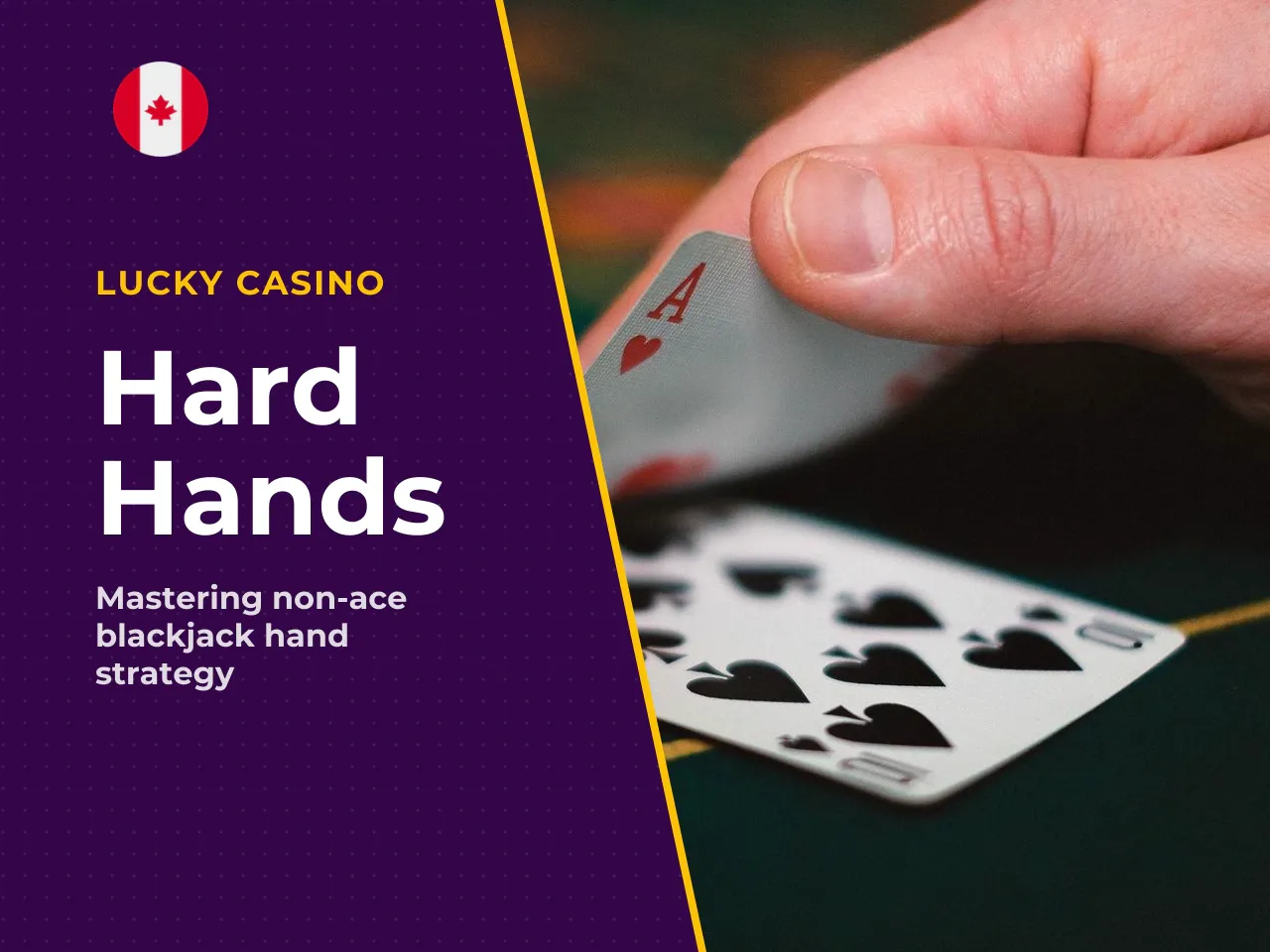
8.1 Hard hands (no Ace, or Ace counted as 1)
- 8 or less:always hit.
- 9:double if the dealer shows 3–6; otherwise hit.
- 10:double if the dealer shows 2–9; otherwise hit.
- 11:double if the dealer shows 2–10; hit if the dealer shows an Ace.
- 12:hit against a dealer 2 or 3; stand against 4–6; hit against 7 through Ace.
- 13–16:stand against a dealer 2–6; hit against 7 through Ace. (With surrender available: surrender 16 vs 9, 10, A and 15 vs 10.)
- 17–21:always stand.
8.2 Soft hands (Ace counted as 11)
- A-2 / A-3 (soft 13–14):double against 5–6; otherwise hit.
- A-4 / A-5 (soft 15–16):double against 4–6; otherwise hit.
- A-6 (soft 17):double against 3–6; otherwise hit. Never stand on soft 17.
- A-7 (soft 18):stand against 2, 7, 8; double against 3–6; hit against 9, 10, Ace.
- A-8 / A-9 (soft 19–20):always stand.
8.3 Pairs: when to split
- A-A and 8-8:always split. Two Aces turn a miserable soft 12 into two hands starting at 11. Two 8s turn a losing 16 into two live 8s. (Remember: split Aces get one card each.)
- 10-10:never split. A hard 20 wins the large majority of the time; breaking it is one of the costliest errors in the game.
- 5-5:never split. Treat it as a hard 10 and double against a dealer 2–9.
- 2-2 / 3-3:split against 2–7; otherwise hit.
- 4-4:split only against 5–6; otherwise hit.
- 6-6:split against 2–6; otherwise hit.
- 7-7:split against 2–7; otherwise hit.
- 9-9:split against 2–6 and 8–9; stand against 7, 10 and Ace.
Memory anchor for beginners: Always split Aces and 8s. Never split 10s and 5s. Double on 10 and 11. Stand on 17 and up. Decline insurance. Those five lines alone capture most of the value of the full table.
8.4 The four "strategies" to avoid
- Chasing losses with bigger bets. No staking pattern converts a negative expectation into a positive one.
- Mimicking the dealer (standing on all 17s regardless of the upcard). It ignores the dealer's upcard entirely and costs you several percentage points.
- Never busting (standing on every 12+). It surrenders every marginal hit and is far worse than basic strategy.
- Taking insurance "to protect a good hand." Insurance and your main hand are mathematically unrelated. A 20 does not make insurance a better bet.
- Why No Strategy Guarantees a Win
This is the section most casino guides skip. It matters more than the strategy chart.
Blackjack outcomes depend on a random card sequence, on the dealer's forced completion rules, and on a nonzero house edge. Basic strategy maximises expected value. It cannot make any single hand, session or lifetime certain. Three structural reasons:
- The bust asymmetry. If you bust, you lose immediately, even when the dealer subsequently busts too. You act first; the house never has to risk anything on hands you have already lost.
- Pushes and dealer blackjacks. Even perfect play produces ties and dealer naturals. The distribution of outcomes always contains losses.
- Rules move the edge, not the risk. More decks generally worsen player odds. A 6:5 payout worsens them further. H17 worsens them again. What changes is the size of the house edge, never its existence.
Progression systems fail for the same underlying reason. Bet sizing changes the shape of your results distribution, meaning more frequent small wins and rarer catastrophic losses, but it cannot change the sign of the expectation. With a finite bankroll and a table maximum, a long enough losing run always breaks the system.
Fact check on a common claim. "This betting strategy guarantees a winning session" fails on two counts. First, the blackjack rules themselves fix the dealer's draw and the payout ratio, so no wager sequence alters the per-hand expectation. Second, every blackjack casino publishes table maximums, which cap the recovery step a negative progression depends on. If a site or a forum post promises guaranteed winning, that is your signal to close the tab.
«Basic strategy is the mathematically best play for a fixed rule set, but the casino still retains an edge.» Wizard of Odds, blackjack analysis (2024). https://wizardofodds.com/games/blackjack/
For deeper reading on how game math, RTP and operator economics interact across products, see our analysis of casino game mechanics and operator economics.
10. Betting Systems Compared, With the Actual Math
A betting system is a rule for how much to wager next, based on what just happened. It is not a playing strategy and it does not interact with basic strategy. Here are the five systems players actually use.
| System | Progression type | How it works | Risk level | The main danger |
|---|---|---|---|---|
| Martingale | Negative | Double after every loss ($10, $20, $40, $80). One win recovers all prior losses plus one base unit. | Very high | A 10-hand losing streak from a $10 base costs $10,230 in total wagers, and usually hits the table maximum before recovery. |
| Paroli (Parlay) | Positive | Double after every win; reset to base after three consecutive wins. | Low | A loss on the third step erases the accumulated profit of the cycle. |
| Oscar's Grind | Incremental | Keep the bet flat after a loss; raise it by one unit after a win. Target: one unit of profit per cycle. | Low to medium | Long flat stretches with no win streak; cycles can run a very long time. |
| 1-3-2-6 | Fixed 4-step cycle | Bet 1, 3, 2, 6 units on consecutive wins ($10, $30, $20, $60), reset on any loss. | Medium | Losing on step four burns the cycle's entire accumulated profit. |
| Flat betting | None | The same stake on every hand, win or lose. | Minimal | No acceleration; bankroll growth is slow by design. |
The Martingale progression, spelled out
$10 + $20 + $40 + $80 + $160 + $320 + $640 + $1,280 + $2,560 + $5,120 = $10,230.
Ten consecutive losses is not an exotic scenario. At roughly 48% win probability per hand, it happens far more often than intuition suggests across thousands of hands. Add a table maximum of, say, $500, and the sequence physically cannot complete. That is why Martingale is best understood as a way to convert many small wins into one enormous loss.
Warning: negative-progression systems escalate exposure exactly when your bankroll is under the most stress. They are the leading mechanical cause of session-ending losses among recreational blackjack players.
10.1 Flat betting and when to change your bet size
Flat betting is the least glamorous approach and the easiest to audit. One unit per hand, every hand, whatever the last result was. Nothing to remember mid-shoe.
Its real advantage is diagnostic. When your bets are identical, your session result reflects your decisions and the table rules, not a progression that happened to fire or fail. If you are still learning blackjack strategy, that clarity is worth more than any staking curve.
If you do vary your bets, vary them against the table, not against your feelings:
- Match the unit to the table minimum first. A $25 minimum table with a $300 bankroll is not a betting decision, it is a mismatch.
- Step up only from realised profit, never from a topped-up deposit.
- Check the table maximum before you start. A progression that cannot complete inside the limits is not a system, it is a countdown.
- Live blackjack complicates it. Timed betting windows push you into rushed sizing, and the pace at a live table leaves less room to recalculate.
Which system fits you?
- Risk tolerance:low means flat betting or Oscar's Grind. High means 1-3-2-6 offers structure without exponential escalation. Martingale is not recommended at any bankroll size.
- Budget:negative progressions require a bankroll several hundred times your base unit to survive normal variance. Be honest about what you actually have.
- Experience:beginners should start with flat betting for at least a few hundred hands. It makes results readable and keeps drawdowns bounded by session length rather than progression depth.
- Bankroll Management That Actually Holds Up
Bankroll discipline is the only genuinely reliable "system" in blackjack, because it controls exposure rather than pretending to control outcomes.
The four-part framework:
- Define the bankroll. A ring-fenced amount you are fully prepared to lose. Not rent, not credit, not borrowed money.
- Fix the unit. Set your base bet at 1–2% of the bankroll. With a $500 bankroll, that is a $5 to $10 base bet, which immediately tells you whether the $25-minimum table across the room is appropriate.
- Set stopping rules in advance. A stop-loss (say, minus 30% of bankroll) and a stop-win (say, plus 50%). Write them down before the first hand. Decisions made mid-session under emotional pressure are systematically worse.
- Cap session length. Time limits matter as much as money limits. Fatigue degrades strategy adherence, and strategy adherence is the only edge-reducing tool you have.
Table selection is part of bankroll management. A 3:2, S17, six-deck table with double-after-split and late surrender is worth more to your bankroll than any staking pattern applied at a 6:5 table.
12. Blackjack Demo vs RNG Real Money vs Live Dealer
The rules of blackjack do not change between formats. What changes is the delivery layer: who deals, how fast, at what stakes, and what is at risk.
Multimedia placeholder: HTML comparison table with <caption>, <thead>, <tbody>. All comparison parameters are duplicated in the surrounding text.
| Parameter | Blackjack demo (free play) | RNG online blackjack (real money) | Live dealer blackjack |
|---|---|---|---|
| Dealer | Software simulation | Certified random number generator | Real human dealer, streamed from a studio or casino floor |
| Cards | Virtual deck, reshuffled programmatically each hand | Virtual deck, reshuffled programmatically each hand | Physical cards from a real shoe |
| Speed | Fastest, hundreds of hands per hour possible | Very fast, fully self-paced | Slower, typically dozens of hands per hour |
| Decision timer | None | Effectively none | Yes, short betting and decision windows |
| Stakes | $0, no wagering | Low minimums, often from about $0.50 to $1 | Operator and table limits; VIP tables have high minimums |
| Transparency | Rules visible, outcomes RNG-driven | Relies on RNG certification and audited RTP | Visual, you watch the deal happen |
| Mobile availability | Yes | Yes | Yes |
| Best used for | Learning the rules, drilling basic strategy, testing the interface | Volume practice with real stakes, bonus play, low-limit sessions | Casino-floor atmosphere, dealer interaction, side bet variety |
12.1 What blackjack demo mode is genuinely good for
Demo play uses the same rules and the same paytables as the real money version, minus the wagering. That makes it the correct place to do three specific things:
- Rule verification. Confirm the blackjack payout (3:2 or 6:5), the soft-17 rule, and whether double-after-split and surrender exist. A five-minute check that changes the house edge you will face.
- Basic strategy drilling. Run 200 to 300 hands with the strategy card open, until the correct action becomes automatic rather than deliberated.
- Interface familiarity. Find the chip selector, the split and double buttons, the side bet boxes and the autoplay controls before money is involved.
A caveat worth stating plainly: demo play does not replicate the psychology of real stakes. Players who play flawlessly for free routinely deviate the moment real money is on the line. Treat demo as technical rehearsal, not emotional preparation.
12.2 What changes when you play blackjack for real money
- Limits become a filter. Match the table minimum to your unit size (Section 11), not to your ambition.
- Risk perception shifts. Loss aversion pushes players toward insurance, toward standing on 16 "just in case", and toward chasing. Pre-committed rules are the countermeasure.
- Bonus terms interact with blackjack. Many casino bonuses contribute blackjack wagering at a reduced rate, often 5% to 20%, or exclude the game entirely, precisely because its house edge is so low. Read the game-weighting table before you assume a bonus can be cleared at the tables.
- Withdrawals need paperwork. Complete KYC verification early, ideally before your first cashout request. A win held up on document review is the most common complaint I see, and it is almost always avoidable.
Responsible gambling note: blackjack real money play carries genuine financial risk. Strategy and bet sizing do not guarantee a win. Decide your stake limit, your loss limit and your session length before the first hand, and set those limits inside your account rather than in your head. 19+.
13. Live Blackjack Variants: RTP, Providers and Features
Live dealer blackjack is delivered as a real-time HD video stream from a professional studio, with a human dealer physically handling real cards while you bet through an overlay interface. Evolution, Playtech, Pragmatic Play Live and On-Air Entertainment all operate dedicated studios with variants, side bets and chat functionality.
Top live tables by published RTP
| Game | Provider | Base RTP | Signature feature | Min bet |
|---|---|---|---|---|
| Quantum Blackjack Plus | Playtech | 99.57% | Random card multipliers of up to 3x | $1 |
| All Bets Blackjack Live | Playtech | 99.46% | Six side bets in one interface, including Buster Blackjack | $1 |
| Live Speed Blackjack | On-Air Entertainment | 99.44% | Auto-decision and fast dealing, no waiting on slow players | $1 |
| Live Eclipse Blackjack | On-Air Entertainment | 99.40% | Unlimited seats plus five side bets, including Royal Jacks | $1 |
| Live ONE Blackjack | Pragmatic Play Live | 99.28% | Maximum win up to 2,000x stake | $1 |
Note that a published RTP figure assumes optimal play. Deviating from basic strategy, or piling on side bets, drags your effective return well below the headline number.
13.1 How live blackjack differs from online RNG tables
The core difference is who deals and how fast. At a live table a human dealer draws physical cards from a real shoe, and the cards are shown to camera as they land. At an RNG table the software resolves the round instantly and reshuffles the virtual deck after every hand.
Pace follows from that. Live blackjack runs at dozens of hands per hour with a countdown on every betting window; online blackjack is self-paced, so you can sit on a decision for as long as you like. For drilling strategy, the RNG version wins. For atmosphere, dealer interaction and the sense that nothing is hidden, live wins.
Table capacity differs too. Classic live tables seat up to seven players, while Infinite and Common Draw formats let an unlimited number of players act on one dealt hand, each making their own decisions.
13.2 How to choose a blackjack casino for live dealer play
Run four checks, in this order:
- Which live studios the operator actually carries. Playtech, Pragmatic Play Live, On-Air and Evolution tables differ in RTP, side bets and limits, so a long list of popular blackjack tables is worth more than a big number in the lobby banner.
- Limits per table, both ends. Confirm minimum and maximum bets in CAD before you sit, and check that the minimum matches your unit size.
- Rule set per variant. Payout ratio, soft-17 rule, deck count, DAS and surrender. Two tables in the same lobby can differ.
- Stream quality and mobile behaviour. A live table that buffers during the betting window costs you decisions. Test it on the device you actually play on.
13.3 Why live blackjack has no free demo mode
This question comes up constantly, and it has a straightforward economic answer. RNG games cost essentially nothing to run per round, so operators can offer unlimited free play as a marketing funnel. Live tables carry real marginal costs on every single hand: dealer salaries, studio floor space, multi-camera production, streaming bandwidth, real cards and shoes, and pit supervision. A free live table would burn those costs with no possibility of revenue.
The practical workaround: rehearse in the RNG demo version of Classic Blackjack, where the rules, payouts and correct decisions are identical, then move to live tables once your decisions are automatic. Some operators also let you watch a live table without betting, which is the closest thing to a live demo and is genuinely useful for learning the pace and the betting-window timing.
Other live and online variants worth knowing
- Classic Blackjack:usually eight decks from a shoe, few or no side bets. The best starting point for beginners, and the format where basic strategy applies most cleanly.
- VIP Blackjack:restricted access with much higher minimum and maximum limits. Same math, larger swings.
- Party Blackjack:standard rules with multiple players at one table, plus dealer and player chat. Social, slower.
- Common Draw / Infinite Blackjack:an unlimited number of players share one dealt hand, and everyone makes their own decisions. Zero seat competition, no waiting.
- Speed variants:auto-decision after the timer expires. Excellent for volume, punishing for indecision.

- How to Vet a Casino and a Live Table
Four verifiable criteria, in order of importance:
Licence. A named regulator and a licence number, published and checkable on the regulator's own register. In Canada that means iGaming Ontario / AGCO for the Ontario regulated market, provincial lottery corporations elsewhere (OLG, BCLC, Loto-Québec, ALC, PlayAlberta), or a recognised offshore regulator for grey-market sites. No number, no jurisdiction, no trust.
Published RTP or house edge per variant. A single site-wide "average payout" figure is not enough. A trustworthy operator or provider publishes RTP per blackjack variant, because a 99.57% table and a 97% table are entirely different products.
A complete side bet list with payout rules. Every supported side bet and its full paytable should be documented in the game info panel, not discovered after you have placed the bet.
Explicit min and max limits. Both numbers must be stated up front. Without them you cannot compare tables or size your unit correctly.
Canada-specific checks
- Age:19+ for casino gaming and online casino play in most provinces. Ontario sets 19+ for online casino gaming and land-based casinos, while 18+ applies to lottery and charitable gaming.
- Currency and payments:confirm CAD account currency to avoid a conversion spread on every deposit and withdrawal, and check for Interac e-Transfer or Interac Online support. Interac remains the most widely used Canadian deposit method, alongside iDebit, Instadebit and major cards.
- Withdrawal terms:look for documented processing windows, per-transaction and monthly withdrawal caps, and whether KYC verification is completed before your first withdrawal request.
- Bonus game weighting:verify how blackjack contributes to wagering requirements before you opt into any welcome offer. Reduced weighting is normal here, and it is the clause players miss most often.
For a broader breakdown of licensing frameworks, payment rails and operator due diligence, see our iGaming market and operator review methodology.
15. Side Bets and Progressive Jackpots: Exact Payouts
Side bets are optional wagers settled independently of your main hand. They add volatility and entertainment, and they carry substantially higher house edges than the base game, often in the 2% to 8% range against roughly 0.5% for basic-strategy blackjack. Budget for them as entertainment, not as strategy.
15.1 Perfect Pairs
Wins if your first two cards form a pair:
| Hand | Example | Pays |
|---|---|---|
| Mixed Pair (one red, one black) | 8♠ + 8♥ | 5:1 |
| Coloured Pair (same colour, different suits) | 8♠ + 8♣ | 10:1 |
| Suited Pair (identical suit) | 8♠ + 8♠ | 30:1 |
15.2 TriLux / 21+3
Combines your two cards with the dealer's upcard into a three-card poker hand:
| Hand | Description | Pays |
|---|---|---|
| Mini Royal | A, K, Q, suited | 100:1 |
| Straight Flush | Three in sequence, same suit | 35:1 |
| Three of a Kind | Three cards of the same rank | 33:1 |
| Straight | Three in sequence, mixed suits | 10:1 |
| Flush | Three cards of the same suit | 5:1 |
15.3 TriLux Super3 (add-on bet)
| Hand | Pays |
|---|---|
| Three of a Kind | 90:1 |
| Straight Flush | 180:1 |
| Three of a Kind, all the same suit | 270:1 |
15.4 Blackjack progressive jackpots
Some casinos run fixed-stake progressive side bets, for example set bets at £5 and £10, each with its own jackpot pool. Every time the jackpot bet is played on any participating table, the pool grows across all of them. A progressive jackpot bet may only be placed if a main bet is already in play.
| Player's hand | £10 Progressive | £5 Progressive |
|---|---|---|
| Blackjack | £50 | £25 |
| Ace–Jack (any) | £200 | £100 |
| Same-colour Ace–Jack | £400 | £200 |
| Suited Ace–Jack | £500 | £250 |
| Suited A-J + dealer A-J (secondary suits) | £20,000 | £5,000 |
| Suited A-J + dealer A-J (jackpot suits) | Jackpot | Jackpot |
15.5 Buster Blackjack and other live-only bets
Live tables from Playtech and On-Air add bets such as Buster Blackjack (paying on the number of cards in the dealer's busted hand), Royal Jacks, Hot 3 and Bust It. The rule of engagement never changes: read the full paytable in the game info panel, and treat any side bet as a separate product with its own, considerably worse, expected value.
16. Responsible Gambling
Blackjack has one of the lowest house edges in the casino, which makes it easy to underestimate. A low edge is still a negative edge. Over enough hands, the mathematics favour the operator without exception.
«Gambling products have negative expected value for most players.» UK Gambling Commission, Consumer Choice Survey (2024). https://www.gamblingcommission.gov.uk
«People can lose more money than planned; pre-set limits help control spend and session length.» NHS England, Gambling harms guidance (2023). https://www.nhs.uk
«Limit-setting tools, including deposit limits and session limits, are core harm-minimisation measures.» European Commission, responsible gambling materials (2024). https://commission.europa.eu
Practical controls to activate before your first hand:
- Deposit limits, daily, weekly or monthly, set in the account settings rather than in your head.
- Session and time limits, plus reality-check reminders.
- Loss limits and a firm stop-loss rule.
- Self-exclusion and cooling-off options, which every licensed operator must provide.
- Canadian players can also use provincial tools such as OLG's My PlaySmart suite in Ontario, and equivalent programmes from other provincial operators.
If gambling has stopped being fun, that is the signal to stop playing and seek support. Free, confidential help is available across Canada through provincial responsible-gambling helplines and ConnexOntario.
Disclaimer
This article is provided for informational and educational purposes only. It is not financial, legal or investment advice, and it is not a guarantee of winnings. Gambling involves a mathematical house advantage and a real risk of financial loss. No strategy, chart or betting system described here can eliminate that risk or produce guaranteed profit. Blackjack rules, payouts, RTP values, side bet paytables, betting limits and legal availability vary by operator, software provider, province and jurisdiction, so always verify the specific rules and terms of the table you are playing. Online gambling is restricted to 19+ in most Canadian provinces (18+ for lottery products in Ontario) and may be unlawful in your jurisdiction. Play only with money you can afford to lose.
- FAQ: Blackjack Online and Live Dealer
Can I play blackjack completely free before betting real money?
Yes. RNG blackjack demo versions are widely available, use identical rules and paytables, and require no deposit or registration at many sites. Use demo mode to verify the rule set, drill basic strategy and learn the interface. Free play does not reproduce the psychological pressure of real stakes, and note that live dealer tables do not offer a free mode, because each hand carries real operating costs.
What's the real difference between RNG blackjack and live dealer blackjack?
The rules are the same; the delivery differs. RNG uses a certified random number generator, a virtual deck reshuffled every hand, and self-paced play, which is better for beginners drilling volume. Live dealer blackjack uses a human dealer, physical cards and a timed betting window, which is better for players who want casino atmosphere and dealer interaction. Live is slower: dozens of hands per hour against potentially hundreds.
Which is the best blackjack format for a beginner?
Start in demo Classic Blackjack, move to low-limit RNG tables for real money, then try live once your decisions are automatic. That order keeps the learning cost low and the surprises small.
Does basic strategy guarantee I'll win?
No. It minimises the house edge to roughly 0.5% under favourable rules, which means it minimises your expected loss rate. Over any finite number of hands, results are dominated by variance.
Is card counting possible online?
Not meaningfully. RNG games reshuffle the virtual deck after every hand, which removes the deck composition that counting depends on. Live tables use continuous or frequent shuffles, multiple decks and camera-based countermeasures, and online betting patterns are logged.
Should I ever take insurance?
As a default rule for a basic-strategy player, no. Insurance is priced at 2:1 when the true odds are worse than that, so it carries a negative expected value, including when you hold 20.
What does "dealer stands on soft 17" mean for me?
It means the dealer stops drawing at A-6. S17 is more favourable to you than H17, where the dealer must draw, which adds roughly 0.2% to the house edge. Prefer S17 tables.
Why should I avoid 6:5 blackjack tables?
Because the same natural blackjack pays $12 profit on a $10 bet instead of $15. Depending on the rest of the rule set, that downgrade adds around 1.4 percentage points to the house edge, roughly triple the entire benefit you gain from perfect basic strategy.
Are side bets worth playing?
They are worth playing for entertainment, not for return. Perfect Pairs, TriLux/21+3, Buster and progressives all carry substantially higher house edges than the main bet. Fund them from a separate, small entertainment budget.
Does the Martingale system work?
No. It converts many small wins into occasional catastrophic losses. Ten straight losses from a $10 base cost $10,230 in wagers, and table maximums typically interrupt the progression before recovery is possible. No staking pattern alters the house edge.
Can I split Aces and then keep hitting?
No. Standard casino rules give you exactly one additional card per split Ace. And a split Ace plus a ten-value card counts as 21, not blackjack, so it pays 1:1 rather than 3:2.
Is surrender always available?
No. Late surrender is a table-specific rule, is typically not offered in double-deck games, and is absent from many online variants. Where it exists, it returns 50% of your stake and is correct on hard 16 vs 9/10/A and hard 15 vs 10.
What's the minimum bankroll for a $10 table?
Using the 1–2% unit rule, a $10 base bet implies a bankroll of roughly $500 to $1,000 to absorb normal variance without a session-ending drawdown.
Do I have to use hand signals at an online table?
No, online play uses buttons. Hand signals apply in land-based casinos and matter if you plan to move from screen to felt. Learning them costs five minutes and prevents the most common rookie friction at a real table.
Does blackjack count toward casino bonus wagering in Canada?
Often only partly. Many operators weight blackjack at 5% to 20%, and some exclude it outright, because the house edge is so low. Check the game-weighting table in the bonus terms before you deposit for an offer.
- Pre-Play Checklist
Run through this before your first hand at any new table:
- I know the object: beat the dealer, don't exceed 21.
- I know card values: 2–10 face value, J/Q/K = 10, Ace = 1 or 11.
- I can tell a soft hand from a hard hand.
- I have confirmed the blackjack payout is 3:2, not 6:5.
- I have checked the soft-17 rule (S17 preferred over H17).
- I have checked deck count, double-after-split, re-split and surrender availability.
- I know the dealer must draw below 17 and stand on 17 to 21.
- I have my basic strategy card for hard hands, soft hands and pairs.
- I will always split A-A and 8-8, and never split 10-10 or 5-5.
- I will decline insurance by default.
- I know the hand signals if I'm playing at a physical or live studio table.
- My base bet is 1–2% of a ring-fenced bankroll.
- I have written down a stop-loss, stop-win and time limit.
- I have chosen flat betting over any negative progression.
- I have verified the operator's licence number and regulator.
- My account is in CAD and supports a payment method I actually use, for example Interac.
- I have read the side bet paytables and set a separate budget for them.
- Deposit, loss and session limits are switched on in my account settings.
Compare tables on the facts, read the terms before you deposit, and play responsibly. 19+.